
Employee participation — When leadership needs to be accounted for

Content

ESOps in Swiss SMEs: Figures, Governance, Mini-Cases & FAQs — so that motivation becomes a measurable strength.
Category: Insights · Reading time: 8—9 min · Switzerland/SMEs/ESOP
1. Why employee participation puts leadership to the test
More and more Swiss SMEs are using participation models (ESOP/VSOP) to retain key people, secure succession plans or strengthen culture. What sounds like “motivation” is in fact a legal and accounting obligation system.
Fact: According to district letter 37A of the FTA, personnel expenses are only recognized if they recorded in good time, Valued at market value and duly accounted for is. If one of these elements is missing, there is a risk of tax non-recognition — and an incentive becomes de facto-Dividend loss.
“Without a clean booking, there is no tax effect. ”
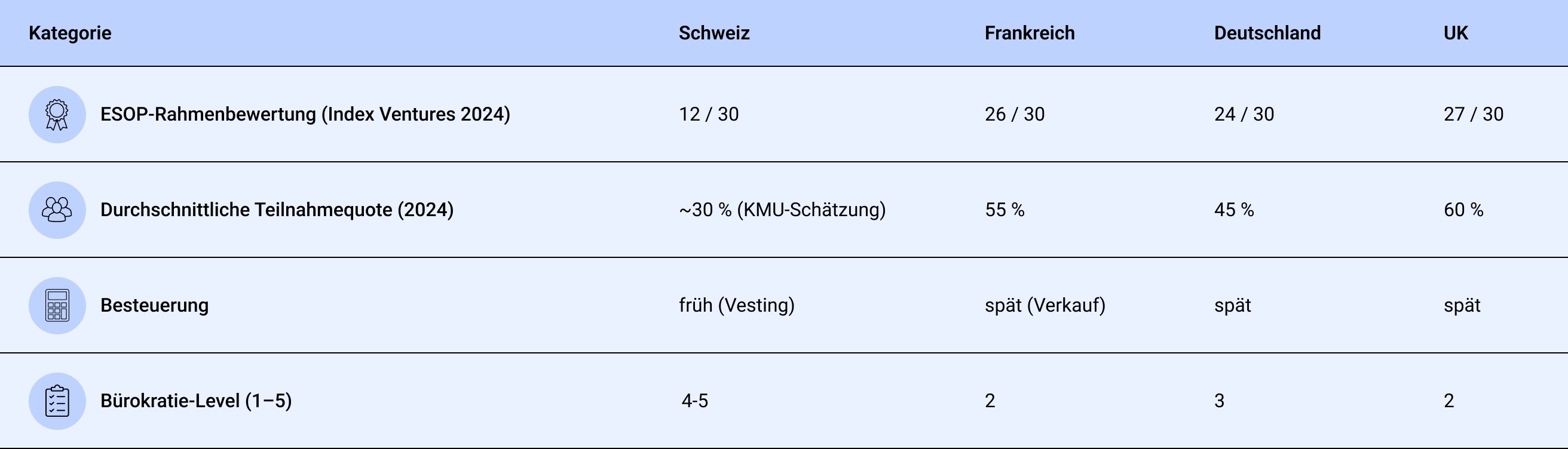
Infobox — Switzerland in a European comparison
Interpretation: Swiss companies are struggling with earlier taxation and higher complexity. Make the difference Governance, ruling and booking quality.
2. Accounting perspective: What really counts in practice
A publicly traded company knows the share price. At most, an SME knows the income value — and that fluctuates. This is where the biggest mistakes occur.
Mini-Case A — Phantom Shares, Zurich
VSOP · 30 FTE — Expenses only booked upon exit → no tax recognition. After-tax + AHV correction. Today: annual accrual, Formula value, VR resolution. Lesson: Timing beats intent.
Mini-Case B — family company, Aargau
Real stocks · 80 FTE — Repurchase window every 24 months, 10% cap, external plausibility check. Participation rate: 48%. No disputes. Lesson: Structure replaces mistrust.
Core obligations for SMEs without a stock exchange rate
- Rating: Formula value in accordance with practice (e.g. income value×2 + net asset value×1, divided by 3) — document annually.
- Approach: Liability in accordance with Art. 959 (5) OR when the obligation arises.
- Periodization: Spread expenses over the vesting years (not just when exercise/exit).
- Tax clarity: Obtain a ruling for payroll/AHV/withholding tax before roll-out.
- Governance: Board resolution, evaluation note, HR—Finance—Tax Jour Fixe.
Guideline: Equity incentives require accounting discipline. Leadership starts with vision — but it only survives with structure.
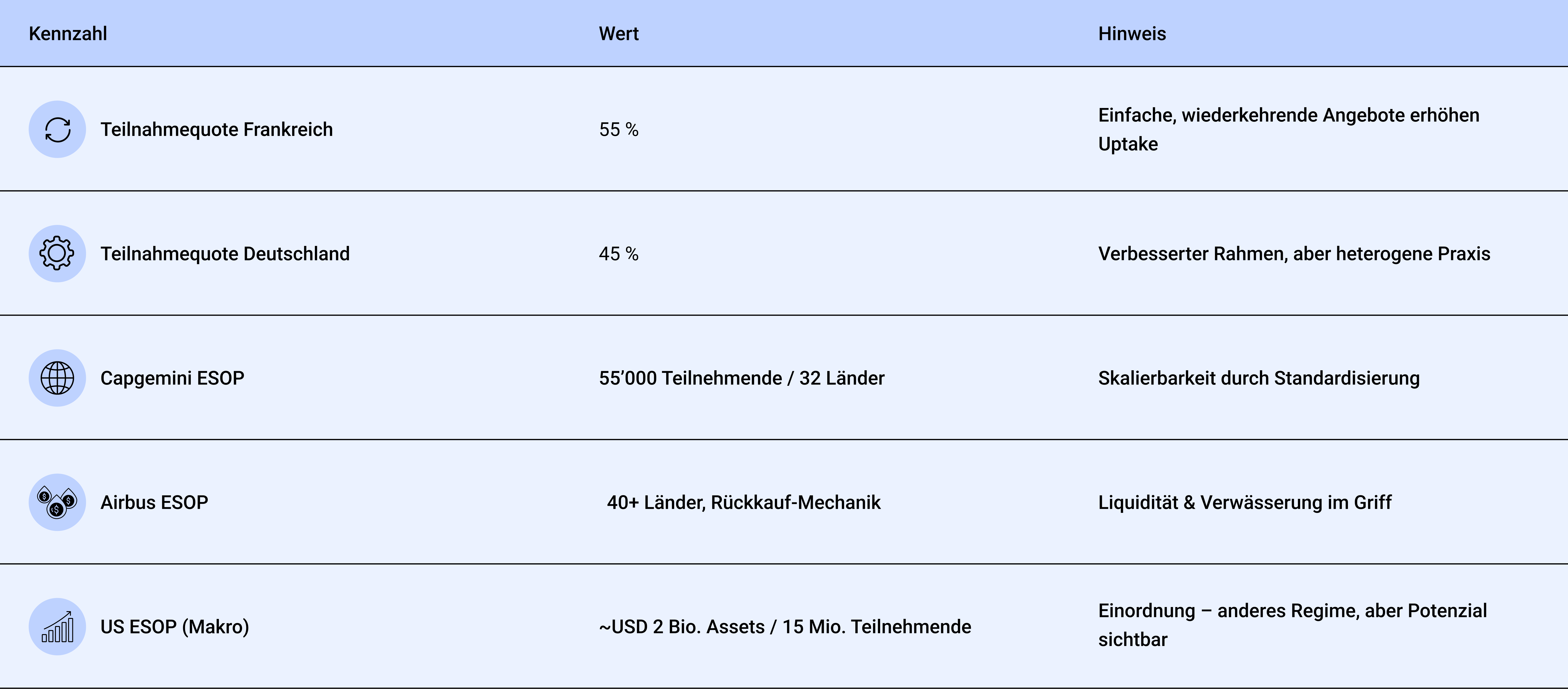
Infobox — European Benchmarks (2024/25)
3. Voices from practice & politics
“Switzerland's legal and tax framework is less favorable... hurdles disadvantage young and high-growth businesses.” — Swiss Startup Association (2024)
“Geneva allows tax-free capital gains upon exit — particularly for startups and SMEs.” — Practical update (2024)
“Seven European countries are now matching the USA — others, including Switzerland, are hanging back.” — Commentary (2025)
4. Practice guidelines for Swiss SMEs
- Rating: Income value/DCF or formula value; external plausibility check increases acceptance.
- Capture: Expenses over the vesting period; not “on suspicion” at the end.
- Communication: One-pager for employees (value formula, deadlines, net effect, leaver rules).
- Taxes & AHV: Clarify mechanics early on with the canton/authorities (ruling).
- Liquidity: Put/call, caps, tranches; think about VSOP cash planning & AHV.
5. FAQ — The 6 most common questions
1) How do you value an SME without a market price?
With a comprehensible process (formula value of income value & substance or simplified DCF). Update and document annually; external plausibility check recommended.
2) When must the expenses be booked?
Over the entire vesting period from allocation. Not just when exercise/exit — otherwise there is a risk of tax non-recognition.
3) Are Phantom Shares (VSOP) easier?
Administratively, often yes, but they have a salary character (AHV/withholding tax obligation) and require liquidity when making a payout.
4) What happens if we don't book anything at all?
There are no tax expenses — payments are treated as (hidden) dividends. Risk: additional tax, interest on arrears, damage to reputation.
5) Do we need a ruling?
Yes, especially for unlisted companies. A ruling clarifies valuation, payroll/AHV/withholding tax in advance and reduces audit risks.
6) How do we explain this to employees?
With a clear one-pager: value formula, vesting calendar, net scenarios (timing, taxes/AHV), leaver rules. Comprehensibility increases participation and reduces misunderstandings.
6. Leadership grade & conclusion
An ESOP isn't an HR gadget. He is Corporate finance with a human face. Whoever awards shares leads with trust. Whoever accounts for them correctly leads with structure.
Equity incentives require accounting discipline. Leadership starts with vision — but it only survives with structure.


Finally understand what is
really happening in your company.
MKY supports you with accounting, payroll, and taxes – for better decision-making, less administration, and greater financial clarity.
